
I was reading an article written by Tara Ross at This Day in History today and it got me thinking. The article pointed out first that we used to celebrate January 8th as a second Independence Day, for that is the day we claimed victory in the War of 1812. But the story was more about the last major battle of that war, The Battle of New Orleans. And I immediately thought of the song which is about it.
The song The Battle of New Orleans was written by a friend of mine. Jimmy Driftwood was my dad’s neighbor in Arkansas. He lived less than a mile and a half on a dusty dirt road from my dad in the early eighties. I spent some hours with the man when I lived there for a year in ’84.
Jimmy was quite the songwriter in his long life. And an entertainer/teacher. I know those two occupations don’t really get mentioned together like that often, but Jimmy was a teacher. He was the school teacher at the Timbo Arkansas school. And the school was the proverbial one-room schoolhouse. When he retired from schooling, he used his talent of catching kids imaginations and expanded to catching people of all ages with his wit, his quick mind, and his huge personality.
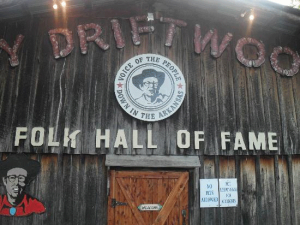 Jimmy had a venue in the big town of Mountain View, population 2,000, about 10 miles or so from his farm in Timbo. It was called Jimmy Driftwood’s Barn. They had music there a few nights a week and also was the home base for the Rackensack Society, a group of folks who sought to preserve the old-time folkways of the Northern Arkansas culture. They mainly used that to preserve the arts and music. And members performed at Jimmy’s Barn the songs of the old Ozark hills.
It was an actual barn, with a stage installed on one side and chairs, benches, and church pew-like rows of seating facing the stage if they didn’t get moved around. There was a backstage area and a nice yard out the back where musicians would hone their set to play at the volunteer shows on a couple days of every week. The shows were free and attended by tourists in town for whatever they were there for. Usually, during tourist season the place was full. The shows were mostly bad musicians who couldn’t sing very well. But there were a few really good entertainers that showed up every week. Jimmy was usually the star.
His charisma made him huge on that stage. He would play some songs, but the best part of Jimmy was his story-telling. I heard him quite a few times. He wrote his songs, in many cases, as a tool to teach his students and The Battle of New Orleans was one of those. It also made him rich when Johnny Horton released his record of it in the fifties.
The song was the facts. He told of the battle which was a bloody affair. He talks of General Andrew Jackson and names him in the song, the blood bath is in the song, the retreat of the British was in the song, and even the chase through the brambles is there. He taught his kids history with songs.
Jimmy recited all of that in his stories on stage and at his house sitting at the breakfast table. He would tell all the tourists at every show to come on out to his farm and have breakfast with him and his wife Cleda. And it wasn’t an idle invitation. He was serious. He would explain how to get there and tell the folks to come on out early in the morning and just come on in through the back door. He said, “If we ain’t there, we’re just out sloppin’ the pigs, and we’ll be right in. Make yerself ta home.”
I had breakfast there with them a few times, then Jimmy would tell the stories of his long life. He was the greatest story-teller I ever listened to. And come to think, the second best was another man from that area named, Glenn Ohrlin. Seems the hills of north Arkansas has a propensity of story-tellers and tall-tale artists.
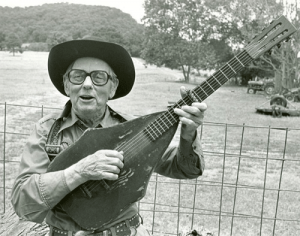 Jimmy Driftwood was a true entertainer and most of all a teacher of all. I will never forget Jimmy in his red shirt with his string tie and his black cowboy hat, and his wonderful wife Cleda. I especially could never forget Jimmy’s unique guitar pictured here. I never saw it but he also told of another guitar he had made out of a pine stump. He carved it out and put a neck and strings on it. He said it didn’t sound so good.